Benjamin Kaita
Exhibition Information
- Artist: Benjamin Kaita
- Exhibition: Nuccio Group, Near Far
- Media: Charcoal on paper
- Gallery: Dutzi
About the Artsist
Benjamin Kaita, Ben, is a undergraduate transfer student at Long Beach State’s School of Arts. He is currently pursuing his BFA in Drawing and Painting. His current emphasis is on charcoal drawings. In his submission, he created four different pieces revolving around the topic of horses. In these pieces, he is explaining his definition of Near Far which is the separation between humans and nature.
Formal Analysis
When looking at his pieces, Kaita only used charcoal and paper. I asked why, and his simple answer is that he was exploring what he can do with charcoal and paper. On each piece, he spent about one month starting and finishing. He told me that right before the deadline for the gallery, he finished his last piece. I noticed that in each piece, he mentions a horse or draws a horse. I asked why horses, and he responded that he was playing around with the idea of horses and he stuck with it for all these pieces.
Content Analysis
Kaita created four different pieces that were based on the same idea, human being’s relationship to nature.
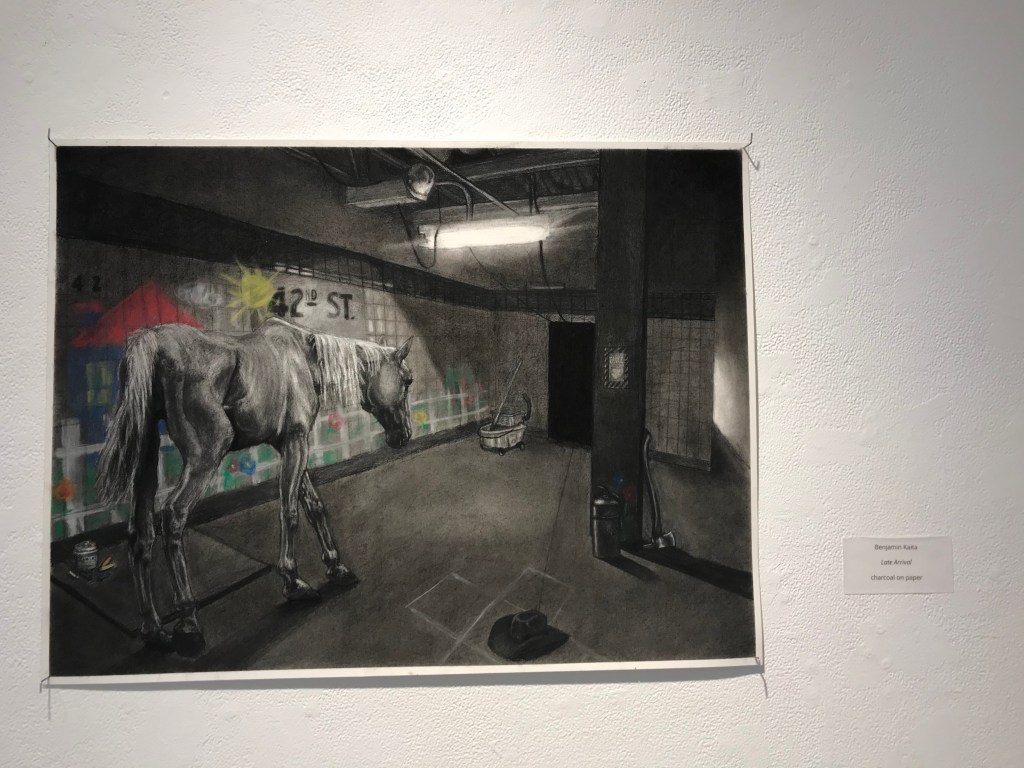
In his first piece, he was depicting the depleting reliance human beings have on horses. Horses used to be the main source of transportation but as technology got more advance, humans rely more on trains and cars to take us places. In this piece he draws picture of a horse with it’s life sucked out of its body roaming around the subways. Kaita explains that the horse is stuck in this subway station that it becomes long forgotten.
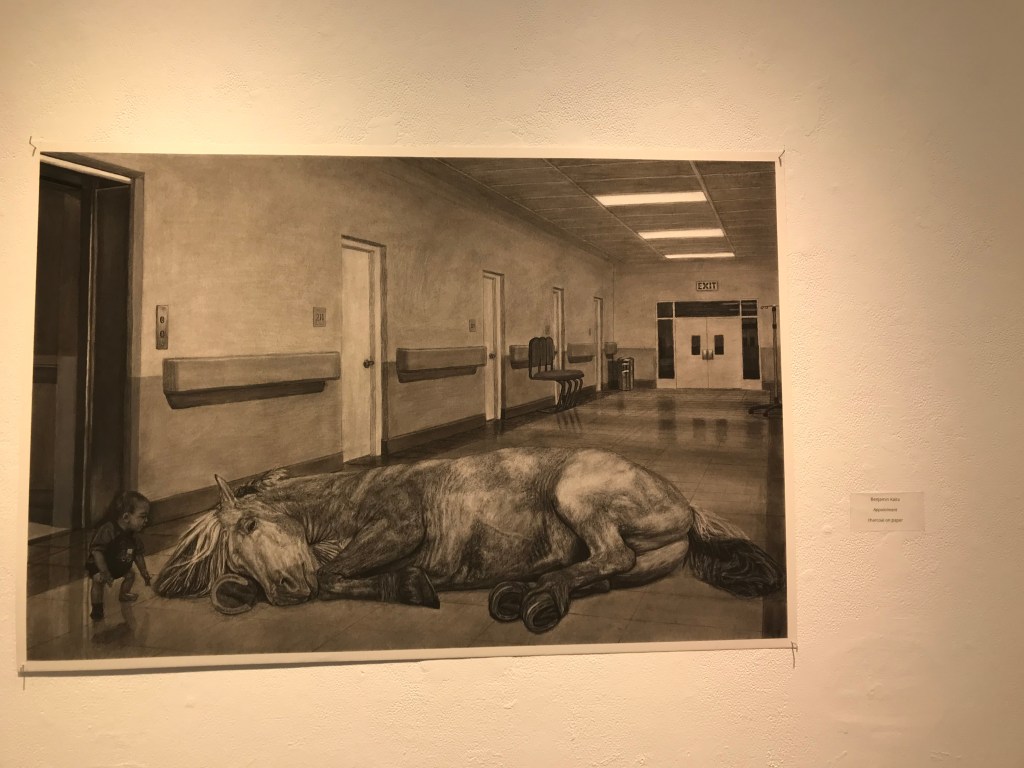
In this second piece, Kaita is trying to depict the different environments nature is present. The horse is a representation of the world of nature. It is placed in a human setting, a hospital. This contrast shows how the humans and nature lives in two different worlds. Humans are so concentrated in their own world, that it’s weird to look at this picture normal because we don’t associate hospitals with nature. Kaita wanted to emphasis the growing divide between the human world and nature.
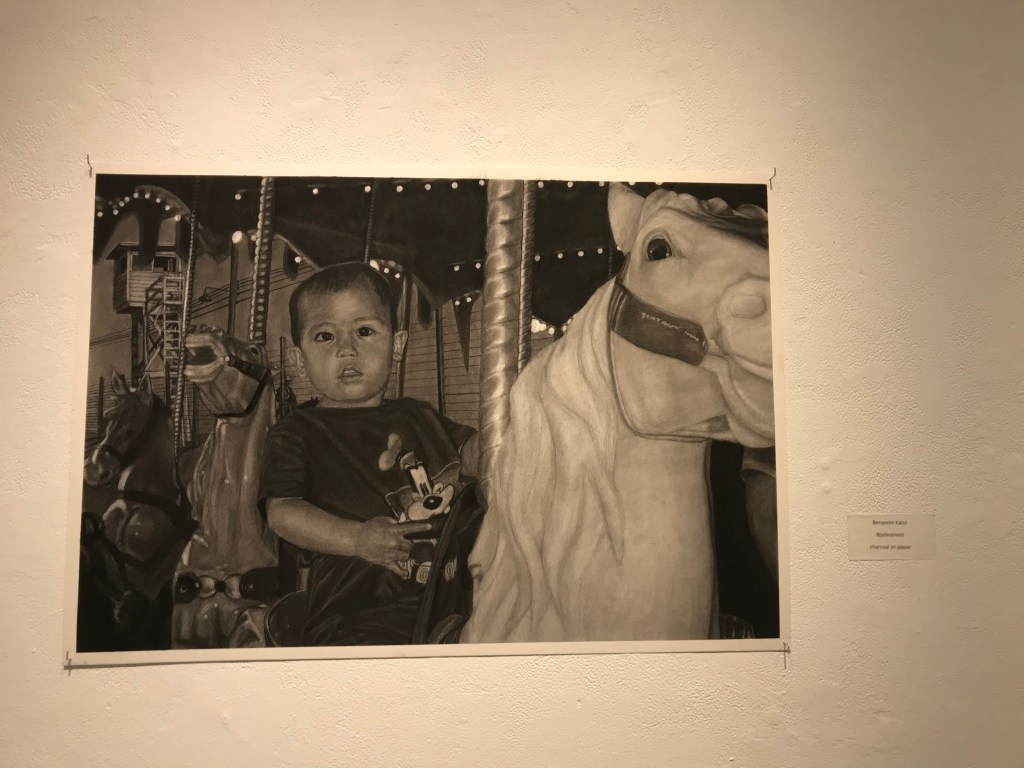
In his third piece, Kaita recreates a childhood photograph of him at a Disneyland carousal, but puts a twist on his photograph. Kaita told me that when he was younger, he lived on a ranch with horses on it. He goes on to tell me that his sister owned a horse that was dear to him and he grew up with the horse. When I asked him about this piece, I asked him if it was a photograph and he told me that it was an old photograph of him at Disneyland. He then went on to tell me the changes he made. In the background, instead of depicting the background of Disneyland, he changed the background to fences. He wanted to show how humans held the horses captive instead of letting them roam free. By adding a fence, he implies how instead of horses roaming free and letting nature guide them, humans take in these horses and imprison them preventing them from freedom.
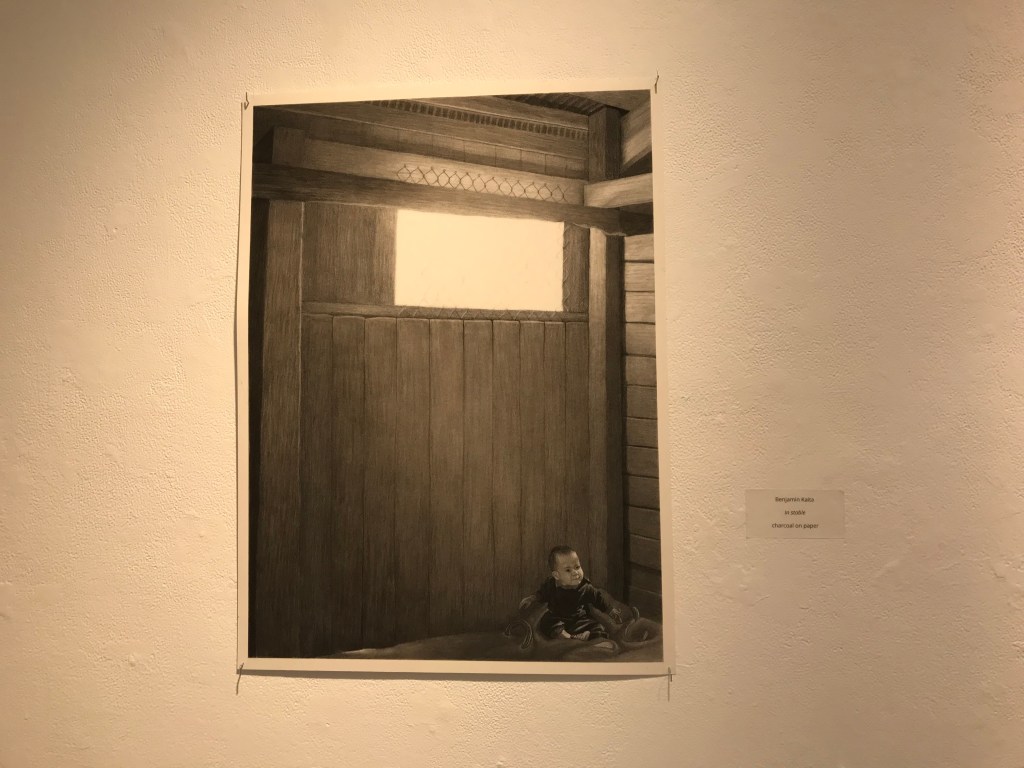
In this last piece, Kaita places a baby in a stable. When I asked about the meaning behind this piece, he went on to tell me about his childhood on the farm. The piece is called “Stable” and he told me that a stable is usually where they store the horses, but when he drew a baby in the stable, he wanted to make the irony of placing a living being in a stable. He explained to me that when placing animals in a stable, we don’t view them as one of us. By placing a human baby in the stable, it makes the viewers be aware of the abuse humans put by placing animals in stables.
My Experience
When looking at these pieces, I was somewhat weird out. I thought Kaita was one of those horse people from my elementary school days, but learning about his process and reasoning to these pieces made me think otherwise. In the topic Near Far, Kaita successfully explains his take on the topic. In each piece, he explains the divided relationship between humans and nature. He explains how misplaced nature is and how blind humans are. When learning about his meaning behind the piece, I was enlightened with his take on human interactions with nature. He explains to me that we often forget the things nature offers us and we end up replacing nature with artificial things.
 Kyra Tan's blog